

Saturday, January 1, 2011

Tuesday, April 13, 2010

The Chinese President Hu Jintao told President Obama that any change to the yuan will be made only for the benefit of domestic interests. He made it clear that if China is going to change the value of the yuan they will not do it because of pressure from the United States. President Hu Jintao stated that reform would come based on China's "own economic and social development needs". Congress has been trying to get the Obama administration to punish China for the exchange rate between the yuan and the dollar because of the high unemployment rate in the US. Jintao said to Obama that a rise in the yuan would not help the unemployment rates in America. He also told Obama that the Chinese government is not intentionally keep the yuan low to gain a trade surplus with the US, and told him that his government would only buy more US goods if Washington relxed controls on exports of high technology goods. The White House's stance on this issue is that there needs to be "a more market-oriented rate". Despite all of the resistance coming from the Chinese government about changing the value of the yuan, economists say that China will indeed re-value their currency by the end of the second or third quarter of this year.
ADB: Developing Asia to grow by 7.5% in 2010
2
http://news.xinhuanet.com/english2010/business/2010-04/13/c_13249408.htm
The ADB (Asian Development Bank) predicts that developing Asia, which includes China, India, and the Southeast Asian region, will grow "7.5 percent this year and 7.3 percent in 2011 on back of a rebound in global trade and ongoing fiscal and monetary stimulus."Apparently due the growth of Asia's industry is leading to even more foreign investment. "The stimulus measures last year will continue to fuel investment in the region, while private consumption is likely to increase as income prospects pick up and unemployment declines," the ADB said. This year, as the global economy recovers, the developing Asian region is also expected to recover. But the region faces some dangers, which may affect its growth potential. These include "a slower global recovery, rising commodity prices, deteriorating fiscal positions and uncertainties as to whether private demand can be strong enough to sustain recovery." The ADB said that Asia's policy makers need to improve its monetary, exchange rate, and fiscal policies to sustain recovery over the long term.
Hu meets with Obama in Washington on China-US ties
2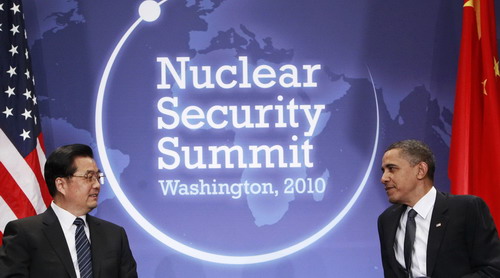
April 12, president Obama and Chinese president Hu Jintao met in Washington to converse about US-China relations. This is the first opportunity for both presidents to discuss problems since Obamas last visit on November. One of the main topics for this weeks discussions was the prevention of nuclear terrorism. since president Obama's election, US-China relations have improved; both sides are giving their best efforts to create a "positive, cooperative and comprehensive relationship in the 21st century."
A healthy and stable relations between the US and china is beneficiary for strategic reasons. in order to maintain a poositive cooperation, the Chinese president has said that they will properly handle issues with Tibet and Taiwan. Both sides keep striving to improve and develop a positive working relation.
http://www.chinadaily.com.cn/china/2010-04/13/content_9719025.htm
China Unmoved on Iran Sanctions
2 China maintains that they are not shifting their position despite White House claims that they have become more open to sanctions in Iran. A spokesperson for the Chinese foreign ministry says that "China has always believed that sanctions and pressure cannot fundamentally resolve the issue". China "upholds its consistent stance on the Iran nuclear issue." Beijing opposes Iran gaining nuclear weapons, rather they support a "dual track strategy," combining negotiations with pressure. The sanctions are aimed at dissuading Iran from proceeding with a nuclear program that many world powers believed is aimed at developing a nuclear weapon. Iran insists it wants nuclear power only for peaceful purposes. The Obama administration along with the Bush administration have struggled to get commitments from China and Russia in its campaign to keep Iran from gaining nuclear weapons. The US has repeatedly claimed progress in winning these nations support only to see them go in a different direction just days later. The Obama administration insists that there is no contradiction between the continuing diplomatic efforts.A senior Obama official said today "We believe a sanctions resolution is the best way to get back to dialogue and negotiations at some stage."
http://www.latimes.com/news/nationworld/nation/wire/sns-dc-china-iran,0,293638.story
Wednesday, April 7, 2010
China Blacklists 100 Journalists For Wrongdoings
2
http://www.chinadaily.com.cn/china/2010-04/08/content_9699239.htm
About one hundred media workers were blacklisted in 2009 for "illegal deeds like bribery and blackmail." More than 20 were convicted of offenses. Apparently more than ten major newspapers nationwide, including the Beijing Times and the Guangzhou-based 21st Century Business Herald, received warnings or were suspended for publishing false reports in 2009.When nine journalists from eight media organizations had received jail sentences, news leaked that journalists were taking hush money to cover up a deadly coal mine accident in north China. They accepted the bribes from the owner of the coal mind to cover up the deaths of over 35 workers in the mine. All in all there were over 76 instances of taking bribes and blackmailing. Punishment will occur.
China Blocks Bobby D??!!
0
http://www.heavy.com/post/china-blocks-bob-dylan-concert-5289
Apparently Bob Dylan was forced to cancel his East Asia tour due to the fact that Chinese officials
told him he was not allowed to play in Shanghai or Beijing. Some speculations on this occurence link this decision to Bjork's "Tibet! Tibet! Tibet!" during a show in Shanghai.
Subscribe to:
Posts (Atom)

 Posts
Posts


